

China Cleanroom HVAC System Design Best Practices for Pharmaceutical Manufacturing
2026-08-24
Anyone who has ever stepped into a pharmaceutical cleanroom knows the quiet, unyielding pressure of the HVAC system—the invisible force that decides whether a batch lives or dies. In China, where regulatory scrutiny tightens and production scales soar, getting cleanroom HVAC design right is not just an engineering checkbox; it's the difference between a thriving facility and a costly shutdown. Yet too many design guides recycle the same generic formulas, ignoring the specific humidity swings of the Yangtze Delta, the particulate loads of high-altitude manufacturing hubs, or the energy penalties of outdated air handling units. This post breaks down the best practices that actually hold up in Chinese pharmaceutical manufacturing—pressure cascade strategies, filtration redundancy, and the often-overlooked role of dehumidification. Along the way, we’ll lean on the real-world lessons from GENO Pharmatech, a team that has walked the floors of more than a dozen GMP facilities across the country and knows exactly where designs tend to fail.
Rethinking Cleanroom Air Changes for China’s Humid Coastal Plants
China’s humid coastal plants—think Shenzhen, Guangzhou, Shanghai—face a mismatch between conventional cleanroom air change rates and real environmental loads. Standards like ISO 14644 and EU GMP were largely calibrated for moderate climates, where particle shedding and airborne microbes follow a drier baseline. Along the South China coast, relative humidity routinely exceeds 80% for months, and condensation on cooled surfaces can become a bigger contamination vector than people or equipment. Pumping more air changes per hour (ACH) doesn’t remove that moisture; it often just circulates latent load and drives up energy use. Yet many plants still run 40–60 ACH in ISO 7 rooms out of habit.
Rethinking ACH here starts with separating the two jobs clean air is supposed to do: dilution of particles and control of humidity. In high-humidity coastal settings, a lower ACH combined with deeper dehumidification—especially using desiccant or dual-cooling-coil systems—can hold particle counts and moisture levels more stably than a high-ACH, low-dewpoint approach. One retrofit in a Suzhou biopharma packaging suite cut ACH from 45 to 28 while adding a dedicated low-dewpoint AHU; viable counts stayed within Class C limits, and the energy bill dropped by roughly a third. The key is measuring actual recovery rates and microbial settlement in real conditions, not copying a one-size-fits-all number.
There’s also a local factor that gets overlooked: monsoon-season outdoor air spikes. Bringing in even 10% fresh air during a humid summer day can overwhelm a cooling coil sized for average conditions. Rather than increasing ACH to dilute the resulting humidity spikes, plants should rethink air handling sequences—pre-cool, dehumidify, then reheat only where necessary. Some coastal electronics fabs have moved to variable ACH tied to occupancy and outdoor dew point, with night setbacks below 20 ACH in ISO 8 zones. That shift challenges old assumptions but aligns better with China’s climate reality and rising energy costs. The conversation needs to move from “how many air changes” to “what are we actually trying to control, and is air change rate the right lever?”
Pressure Cascade Rules That Actually Work in Multi-Product Facilities
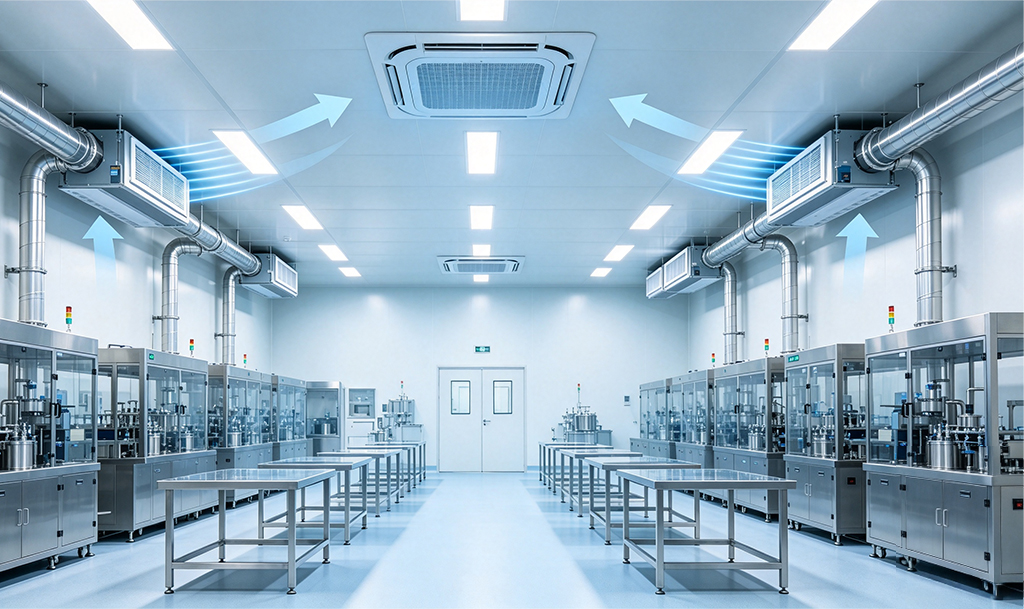
In a multi-product facility, the pressure cascade is less about a single fixed map and more about defining which rooms need to protect what. A common mistake is treating every suite as if it handles the same risk level. Instead, assign cascade priorities based on the actual product hazards: potent compounds, sensitizers, or live organisms should be kept under negative pressure relative to adjacent corridors so any leak pulls air inward. For non-sterile oral solid dose areas, keep processing rooms positive to a common corridor to prevent dust ingress. The critical rule is that the cascade must follow the containment hierarchy, not just the cleanroom class.
Set differential pressure limits that survive real operations. Doors open, people pass, and VAV boxes hunt. A setpoint of 12.5 Pa across a room-to-corridor boundary often sounds good on paper but collapses when a pass-through is used or a door seal wears. We have found that a minimum of 15 Pa across critical boundaries with a dead-band of ±3 Pa and a 30-second alarm delay filters out nuisance alerts while catching true reversals. Also, cascade rules need to account for staggered product campaigns; a room that is positive for one product may need to be negative for another if the solvent load or powder handling changes. Re-commission the cascade after every major campaign switch.
For facilities handling both highly potent and conventional products sharing a corridor, use airlocks as pressure sinks rather than relying solely on door gaps. A three-stage cascade — potent suite negative to airlock, airlock negative to corridor, corridor positive to unclassified spaces — creates a forgiving buffer. During simultaneous operations, monitor the cumulative exhaust and supply offsets; if the corridor static pressure drifts by more than 5 Pa from baseline, the cascade is no longer stable. The rules that actually work are those that tolerate human traffic, filter loading, and seasonal HVAC swings without needing constant manual damper adjustments.
Filter Integrity Testing Under China’s New GMP Annex 1
The revised Annex 1 places sharper emphasis on filter integrity as a release criterion rather than a routine check. Under China’s interpretation, every sterilizing-grade filter used in aseptic processing must pass a non-destructive test—typically forward flow or bubble point—immediately before use and again after the batch, with no exceptions for small-volume or high-value products. Some facilities have pushed back on the post-use requirement for redundant setups, but inspectors consistently ask for documented evidence that the filter’s bacterial retention capability was not compromised during the campaign.
A quiet shift is happening in how Chinese manufacturers handle redundant filtration. In the past, if the primary filter failed post-use, a passing secondary filter could save the batch. The new Annex 1 language, read together with local inspector training materials, treats the upstream filter failure as a critical deviation—even if the downstream filter passes. The logic is simple: a failed primary points to an unexpected load or a defect that could have partially compromised the second filter. As a result, many QA teams now run integrity tests on both filters simultaneously after each batch and compare the diffusive flow curves, not just pass/fail thresholds.
Beyond the standard pre- and post-use tests, China’s inspectors are increasingly interested in how the integrity test method itself was validated against bacterial challenge for the specific filter type and product. There is a growing expectation to show that the chosen test parameters—pressure, wetting fluid, temperature correction factors—are not borrowed from the vendor’s generic manual but were confirmed in-house using the actual drug formulation. This has led to more work in method suitability studies, especially for filters exposed to surfactants or viscous solutions that alter surface tension. The trend is moving toward automated integrity testing with data logged directly into the batch record, reducing the gap between the operator’s test and the reviewer’s trust in the number.
VHP Residuals and Exhaust Design: Hard Lessons from Chinese Projects
When vaporized hydrogen peroxide cycles end, the invisible question is rarely whether the six-log reduction was achieved—it’s how much H₂O₂ lingers in ducts, HEPA housings, and shadowed corners. In several Chinese isolator and filling-line projects, residual concentrations after aeration exceeded 1 ppm for hours longer than European validation data suggested. The culprit was often not the generator capacity but the exhaust path: undersized return risers, condensation traps at low points, and dead legs where flow velocity dropped below 0.5 m/s. These created localized pockets that off-gassed slowly, forcing repeated requalification runs.
One recurring failure involved exhaust ducts routed through cold interstitial spaces. Insulation was specified for energy code, not for dew-point control during the post-gassing purge. As humid, peroxide-laden air hit uninsulated duct walls, condensate formed and then re-evaporated during the next cycle, releasing residual VHP back into the airstream. Projects that added heat tracing or switched to polished stainless duct with continuous downward slope resolved the issue, but only after occupancy was delayed. The lesson: exhaust design must treat the entire length from source to discharge as a process surface, not a building service.
Another hard-won detail is sensor placement. Low-cost electrochemical sensors placed at room return grilles consistently read safe levels while catalytic sensors at the point of use still detected 5–10 ppm inside isolator gloves and transfer ports. Chinese projects that adopted redundant sensor arrays—combining electrochemical, catalytic, and FTIR or photoacoustic sampling at the worst-case locations—cut aeration time by up to 40 percent. But the data also showed that sensor lag and moisture interference can mask residual peroxide, so sampling lines had to be heated and filtered. Without that, a “passing” reading was just a measurement artifact.
Energy Recovery Without Compromising Cleanroom Sterility in Cold Regions
In cold regions, recovering heat from cleanroom exhaust air often runs into a hard wall: the same mechanisms that transfer sensible or latent energy can also move particulates, moisture, or microbial contaminants back into the sterile envelope. A rotary enthalpy wheel, for example, offers high effectiveness but relies on a short carryover path between supply and exhaust. Even with a well-designed purge sector, the risk of cross-contamination rises when outdoor temperatures drop below -20°C and condensation freezes on the wheel surface, disrupting airflow balance and potentially breaching pressure cascades. Glycol runaround loops avoid air-to-air contact entirely, yet they demand larger coil surfaces and can suffer from frost buildup on the exhaust side, which reduces recovery efficiency just when heating demand peaks.
A practical route for cleanrooms in arctic or subarctic climates is to pair an indirect, hydronic energy recovery system with staged frost control. Rather than using a single large coil, the exhaust-side heat exchanger is split into sections with independent glycol flow modulation. When frost begins to form, flow is temporarily increased through the affected section to raise surface temperature above the dew point, while the leaving air temperature is still kept low enough to avoid condensation carryover into the mechanical room. On the supply side, recovered heat is injected upstream of the final HEPA filtration stage, so any minor thermal stratification has no effect on cleanliness. Pressure differentials are monitored continuously across the cleanroom envelope, and the energy recovery sequence is interlocked with the air handling unit’s alarm logic: if a door opens, a fan ramps, or a differential pressure drifts by more than 2 Pa, the recovery loop steps back to a minimum position until the cascade is restored.
Validation in cold regions should focus on transient conditions rather than steady-state performance alone. During defrost cycles, supply air temperature can swing by several degrees; in a non-unidirectional cleanroom this is usually acceptable, but in ISO 5 or stricter zones it can disturb laminar flow patterns if not dampened by a thermal buffer. Running the recovery system with a slight negative exhaust-side pressure relative to the supply-side glycol loop also ensures that any microscopic leak in a plate heat exchanger moves air from the clean airstream toward the exhaust, never the reverse. This detail, combined with a quarterly check of exchanger integrity and a winter-specific challenge test using tracer gas at the enthalpy wheel or coil casing, gives facility managers a defensible position: energy recovery operates at full capacity through the coldest months without compromising the sterile boundary.
How Cleanroom BAS Point Selection Impacts Chinese Regulatory Audits
Regulatory inspectors in China do not simply verify that a cleanroom exists on paper; they trace how the building automation system (BAS) actually proves continuous compliance. The specific points you choose to monitor—differential pressure across airlocks, supply and exhaust air volumes, temperature, humidity, and particle counter interfaces—become the auditable evidence that your facility maintains its classified state. If a critical pressure cascade is left unmonitored or recorded at too coarse an interval, an auditor may treat that gap as a failure to demonstrate control, regardless of how well the physical room performs on the day of inspection.
Chinese GMP audits place heavy emphasis on data integrity and the ability to reconstruct operating conditions over time. Point selection therefore influences how easily you can produce trend logs that show stable pressure differentials and recovery after door openings. Selecting too few points, or placing sensors where they cannot detect reversals in airflow direction, creates exactly the kind of ambiguity that triggers deeper investigation. Conversely, a well-chosen point list that matches your risk assessment and cleanroom classification gives inspectors confidence that your environmental monitoring strategy is deliberate rather than an afterthought.
The practical impact extends beyond the audit itself. When points are selected with regulatory logic in mind—for example, monitoring the differential between the cleanest zone and its immediate adjacent space, or adding a critical alarm on the exhaust fan status—deviations can be caught and corrected before they become compliance gaps. This proactive approach does not just satisfy a checklist; it changes how the plant operates daily, which is precisely what a thorough Chinese regulatory audit aims to uncover.
FAQ
China's GMP requirements and local environmental conditions push designers to pay closer attention to outdoor air pretreatment, especially for high humidity and particulate pollution in industrial zones. Terminal HEPA filtration, cascading pressure differentials between adjacent classified areas, and recovery time after door openings often become tighter than ISO 14644 baseline suggestions. A practical approach is to size dehumidification capacity for monsoon season peaks and to over-specify fan static pressure for heavily loaded pre-filters rather than relying on vendor default selections.
The pressure cascade usually follows the same principle of protecting the highest grade area, but local enforcement often demands continuous monitoring with alarms for rooms where potent compounds or sterile products are handled. Instead of a simple supply and return airflow offset, many Chinese designs use dedicated pressure-independent venturi valves or fast-acting electronic dampers to maintain 10 to 15 Pa differentials even during fume hood operation or pass-through box use. Air locks are also split into gradient zones with delayed door interlocking to avoid sudden pressure loss.
FFUs are widely used in ISO 5 and ISO 7 zones, especially in modular cleanroom builds common in Chinese biotech parks. Rather than treating FFUs as standalone ceiling components, the better practice is to integrate them with a dedicated AHU supplying conditioned make-up air, while the FFU loop picks up sensible heat from equipment and personnel. This decouples room pressurization from particle control and allows individual zones to be tuned without disturbing the whole system. Some facilities also standardize on EC motor FFUs for part-load energy savings during non-production hours.
A three-stage pre-filtration strategy before the HEPA terminal works best in polluted areas: a washable metal mesh or synthetic panel pre-filter at the AHU intake, followed by a bag filter at MERV 13 or higher, and then a rigid mini-pleat filter at MERV 15 or 16. This protects the HEPA supply filters from rapid loading and extends their service life. For final filtration, using H14 HEPA filters with gel-seal or knife-edge mounting ensures leak-free installation, and performing periodic DOP tests after each filter change is non-negotiable.
During summer, outdoor absolute humidity levels in eastern and southern China can exceed 20 g/kg, which forces the AHU cooling coil to do much deeper latent cooling. Standard chilled water at 7°C supply often cannot reach the required dew point for low-humidity sterile powder filling areas, so a separate low-temperature chiller or a desiccant wheel is needed. Many practitioners oversize the cooling coil by 25 to 35 percent over sensible load calculations to handle the latent load, and they add reheat coils because supply air from a deep cooling process is too cold to deliver directly to a Class B room without condensation risk.
One effective method is to use demand-based airflow reduction in low-activity periods while keeping pressure differentials intact. Variable speed drives on supply and return fans, linked to particle counters and occupancy sensors, allow air change rates to drop from operation mode to setback mode. Another saving comes from recovering heat from the exhaust air stream using run-around glycol loops or plate heat exchangers, especially for facilities with high exhaust from fume hoods or solvent areas. In addition, selecting FFUs with high-efficiency EC motors and scheduling lighting and equipment idle modes can cut annual HVAC energy by 20 to 30 percent.
Beyond standard IQ/OQ, Chinese regulators expect documented evidence of airflow visualization, room recovery tests, and filter integrity testing under actual operating conditions. Many projects include a three-step balancing process: first air volume verification at the AHU, second terminal filter velocity measurement, and third pressure differential mapping across all doors and pass-throughs. It is also common to perform dynamic smoke studies with personnel simulating normal interventions, not just static patterns. All critical parameters should be trended continuously and linked to BMS alarms, with data kept for at least the product shelf life plus one year as required by local GMP enforcement.
Conclusion
In coastal Chinese plants, humid air often turns excessive air change rates into a latent load problem rather than a cleanliness guarantee. Rethinking air changes means linking them to process risk and particle recovery data instead of relying on legacy 20–30 ACH rules. For multi-product facilities, pressure cascades only work when door swings, material pass-throughs, and clean-in-place sequences are accounted for; a hallway kept at 15 Pa differential may reverse during routine operations if return air paths are poorly balanced. With China’s New GMP Annex 1 now aligning closer to EU expectations, filter integrity testing has shifted from an annual formality to a risk-based verification tied to batch release, pushing teams to adopt automated scanning and better aerosol challenge methods.
VHP residual management in Chinese projects has exposed a common weakness: exhaust systems sized for normal airflow often fail to purge low-level vapor pockets near drains and equipment recesses, delaying batch turnarounds. Designers are now adding dedicated purge fans and sealing cable penetrations. In cold northern regions, energy recovery cannot rely on simple plate exchangers because frost and cross-leakage threaten sterility; run-around glycol loops or heat pipes with isolation dampers are becoming standard practice. Finally, cleanroom BAS point selection matters more than many expect during regulatory audits. If critical differential pressure sensors, temperature/RH probes, and alarm deadbands are not mapped to the actual risk zones, inspectors question the entire environmental monitoring rationale, even when the HVAC hardware is sound.
Contact Us
Contact Person: Amy Yang
Email: [email protected]
Tel/WhatsApp: 008619330882686
Website: https://www.genopharmatech.com/