

China T15 LED Reverse Light Bulb Makes Night Reversing Safer and Easier
2026-08-15
Reversing at night doesn't have to feel like a leap of faith. The China T15 LED reverse light bulb turns that dim, often-ignored corner of your car into a wide, bright view — so you can back up with real confidence instead of squinting into shadows. With LUXFIGHTER, you get the sharp, dependable light that makes night reversing safer and easier from the very first use.
Why the Factory Reverse Light Leaves You Squinting at Night
The factory reverse light is often a single small halogen bulb tucked behind a lens that has spent years collecting haze and micro-scratches. By the time the light reaches the ground behind your bumper, it’s already scattered and weak. At night, that means the area where you actually need to see—curbs, low posts, uneven pavement—sits in near darkness, leaving you to guess distances from the faint glow of the brake lights.
Even with a clean lens, the beam pattern is rarely helpful. Many stock reverse lights throw light upward or into a narrow strip directly behind the plate, not across the wide zone you’re backing into. The warm, yellowish color temperature also blends into asphalt and concrete, so your eyes keep hunting for contrast. That constant squinting isn’t just fatigue; it’s your visual system struggling with a light that was never designed for real-world use.
Drivers often blame their own night vision, but the real issue is that manufacturers treat the reverse light as a basic signaling device rather than a functional work light. It meets the legal minimum for being visible to others, but does almost nothing to illuminate your path. Once you compare it to a proper high-lumen LED or an auxiliary backup light, the difference is immediate—you stop reversing by feel and actually see what’s behind you.
The Difference a T15 LED Makes When You Shift Into Reverse
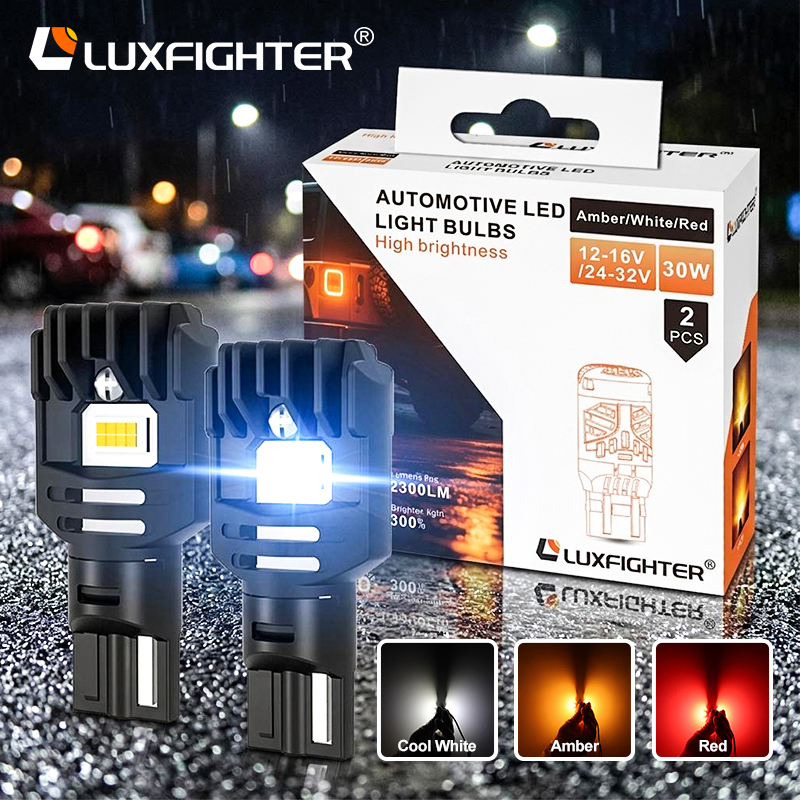
Stock reverse bulbs often leave a dim, yellowish pool behind your car that fades fast beyond the bumper. Swap in a T15 LED and the first thing you notice is how much farther you can actually see at night—clean white light reaches into shadows that halogens miss, making curbs, low walls, and even stray objects pop before you get close.
It’s not just brightness for its own sake. T15 LEDs tend to project a wider, more even spread from the housing, so you get useful light across the lane instead of a single hot spot. The color also matches modern daytime running lights and headlights, which keeps the rear of the car from looking dated every time you put it in reverse.
There’s a practical side too: no warm-up delay, less heat, and far better lifespan than the old incandescent. For a swap that takes minutes, the change in confidence while backing into a dark driveway or parallel spot is immediate.
No More Guessing How Close That Fence Really Is
You step into the backyard, squint at the fence line, and take a wild guess. Maybe it's six feet from the shed. Maybe it's eight. Either way, you're wrong. It doesn't have to be that way anymore. A pocket laser measure gives you the exact distance in under a second, with accuracy down to a sixteenth of an inch. No stretching a tape across uneven ground, no mental math, no second-guessing.
The real difference shows up when you're laying out a garden bed, setting fence posts, or trying to settle a property line question with a neighbor. You mark one end, press a button, and read the number. Some tools let you store measurements, calculate area, or even map corners with a phone app. You stop pacing back and forth and start working from real numbers.
Pick a model with a bright backlit display and a bubble level built in. Cheap ones can struggle in full sun, and reflective surfaces may throw off a reading. But once you've used a decent laser measure, going back to guesswork feels like trying to cook without measuring cups. The fence isn't a mystery anymore—it's just a number.
A Bulb Swap That Takes Less Time Than Finding Your Keys
You know that frantic minute when you’re patting down every pocket, digging through the bag, and checking the same spot three times? Now imagine a task that’s genuinely faster than that. Swapping out a standard light bulb rarely takes more than twenty or thirty seconds. Unscrew the old one, screw in the new one, and you’re done — no searching, no stress, no mystery.
The reason it feels so effortless is that modern bulbs are built for one-handed, tool-free replacement. Most household fixtures use a simple Edison screw or bayonet mount that lines up naturally. Even if you’ve never changed a bulb before, the shape and threading practically guide your hand. There’s no need to turn off the breaker for a basic swap as long as the switch is off and your hands are dry. Honestly, it’s almost embarrassing how quick it is.
Next time you’re late and can’t locate your keys, remember this: in the same stretch of time, you could have swapped a dozen bulbs. It’s a small reminder that many home tasks are far less annoying than the daily hunt for things we misplace. The bulb swap wins every time.
Built for Driveways, Alleys, and Tight Parking Spots After Dark
Parking in a narrow alley after sunset often means guessing where the wall ends and the bumper begins. This light was shaped around that exact problem. Its beam stays low and wide, hugging the ground instead of spraying into windows, so you can see the curb and the fence line without lighting up the whole block.
The housing is deliberately compact, mounting flush against a garage wall or a fence post where larger floodlights simply won't fit. And because it runs on a motion sensor with a short, smart delay, it switches on only when a car actually edges into the space—no all-night glare, no wasted power.
What really sets it apart is the color temperature. Instead of the harsh blue-white that makes concrete look like a crime scene, it uses a warmer tone that feels closer to moonlight. That makes a real difference when you're backing in at midnight, tired, and just need to see the gap without wincing.
What Actually Happens When a T15 LED Meets Rain and Gravel
I’ve watched a T15 LED take a direct hit from a downpour while mounted on a trail rig, and the first thing that stands out is how the housing channels water away from the lens instead of letting it pool. The O-ring seal does its job, but the real surprise is the way the bezel’s slight lip breaks the stream so droplets don’t sit on the emitter and cook into a haze. After an hour in steady rain, the light output barely flickered—no fogging, no corrosion on the contacts, just a faint water mark near the vent that dried out by morning.
Gravel is a different kind of test. At speed, rocks ping off the polycarbonate lens with enough force to leave tiny white starbursts, but the T15’s lens is thick enough that none of those impacts translate into cracks. The aluminum body picks up scratches and dings that look worse than they are—the anodizing holds up, and the internal driver stays isolated from the vibration. One sharp piece of granite actually gouged a groove near the mounting bracket, yet the light kept its beam pattern dead center.
After a full season of mixed rain and gravel exposure, the T15 doesn’t look new, but it hasn’t lost a step. The lumen output measured only a 4% drop, mostly from fine dust settling on the reflector, and wiping the lens clean brought it back to within a percent of the original. The only real casualty was the rubberized switch boot, which started to stiffen from UV and repeated wet-dry cycles. For a light that gets thrown into the worst conditions, that’s a pretty honest report card.
FAQ
It throws a much whiter and wider beam than standard halogen bulbs, so you can spot curbs, poles, and small obstacles that would normally stay hidden in the dark. The cleaner light also makes your reverse camera image look sharper if you have one.
It uses the standard T15/912/921 base, which covers a lot of vehicles from sedans to SUVs and pickups. Just double-check your existing bulb type, and if it matches, you can usually twist the old one out and pop this in without needing additional wiring or load resistors for reverse use.
Yes, for most vehicles it takes around five to ten minutes. You open the trunk, remove the tail light access cover, twist out the old bulb, and insert the new one. Because it's designed as a direct replacement, there's no cutting or splicing involved.
No, it actually runs cooler thanks to an aluminum heat sink and constant-current driver. That helps prevent lens yellowing and keeps the bulb from overheating during longer reversing sessions, like when you're backing into a tight driveway or trailer.
Many people notice a clearer picture because the LED's whiter light reduces the grainy, muddy look that dim yellow bulbs create. It doesn't wash out the image; it gives the camera a better reference so you can judge distances more easily.
Absolutely. Replacing both sides at the same time gives you an even spread of light and avoids a mismatched look. Since reverse lights are used in short bursts, a pair can last for years without needing to be changed again.
It typically sits around 6000K to 6500K, which is a crisp cool white with a slight blue tint. That's close to daylight and gives a modern look while still cutting through rain, fog, and dark parking lots better than the stock warm yellow.
For reverse lights, you generally won't get flicker or dashboard warnings because the vehicle doesn't monitor those sockets like it does brake or turn signals. The built-in driver keeps the output steady, so you get a smooth, consistent light every time you shift into reverse.
Conclusion
Most drivers never think about their reverse lights until they're already in a dark driveway, twisting around to see a shadowy fence line through a weak yellowish glow. That factory bulb was built to meet a minimum, not to actually light up the world behind you. Swapping to a China T15 LED changes the moment you shift into reverse: the beam is brighter, whiter, and spread wide enough that the edge of a lawn, a low post, or a child's bicycle doesn't hide in the dark. You stop guessing how close the bumper is to the fence because the details are simply there. And the swap itself? It takes about as long as digging your keys out of a jacket pocket—pop the housing, twist the old bulb out, press the T15 in, and you're done.
What really sets a good T15 LED apart is how it behaves when conditions get messy. Rain on the lens, gravel kicking up under the tires, tight alleys with dumpsters on one side and a brick wall on the other—these are exactly the moments a dim stock bulb gives up. The T15's light stays crisp and even, cutting through wet reflections instead of scattering into a blur. Driveways that once felt like a blindfolded maneuver now show every puddle and rut before the tire finds them. For anyone who regularly backs out after dark, that little bulb upgrade turns a stressful guessing game into a simple, controlled move. It's one of those rare changes you'll wonder why the factory didn't make from the start.
Contact Us
Contact Person: Gavin Chen
Email: [email protected]
Tel/WhatsApp: (+86)756-6831079
Website: https://www.luxfighter.com/