

China Thoracic Aortic Stent Graft System Innovations for Aortic Repair
2026-10-10
How can aortic repair become safer, more precise, and less invasive? Recent innovations in China's thoracic aortic stent graft systems are challenging old limits. Among them, INT is emerging as a brand to watch, with design breakthroughs that promise better conformability and durable outcomes. From complex arch reconstructions to emergency TEVAR, these advances may soon reshape everyday practice. Read on to explore what's changing—and why it matters for your next case.
Low-Profile Introducers Built for Challenging Iliac Access
Navigating a heavily calcified or tortuous iliac segment often turns a routine access into a prolonged struggle. Low-profile introducers address this by pairing a reduced crossing profile with a tip geometry that eases through irregular lumens. The smaller outer diameter limits vessel stretch and lowers the chance of disrupting plaque, which is especially useful when the iliac artery has diffuse disease or a sharp bifurcation angle.
Material transitions matter as much as the outer diameter. A well-designed low-profile introducer combines a soft, atraumatic tip with a stiffer proximal shaft, so pushability doesn't come at the cost of vessel trauma. Hydrophilic coatings on the distal segment further reduce friction, allowing the sheath to slide past resistant lesions without buckling. Because the wall is thinner, the internal lumen remains adequate for standard interventional devices despite the smaller French size.
During complex peripheral interventions, these introducers cut down on catheter exchanges and keep access stable even when the iliac anatomy works against you. The kink-resistant construction maintains a smooth pathway for balloons, stents, or atherectomy devices, while the reduced footprint helps preserve the access site for repeat procedures. A low-profile platform isn't just a convenience—it can be the difference between a successful revascularization and a failed approach.
Conformable Proximal Cuffs Matching Steep Arch Angles
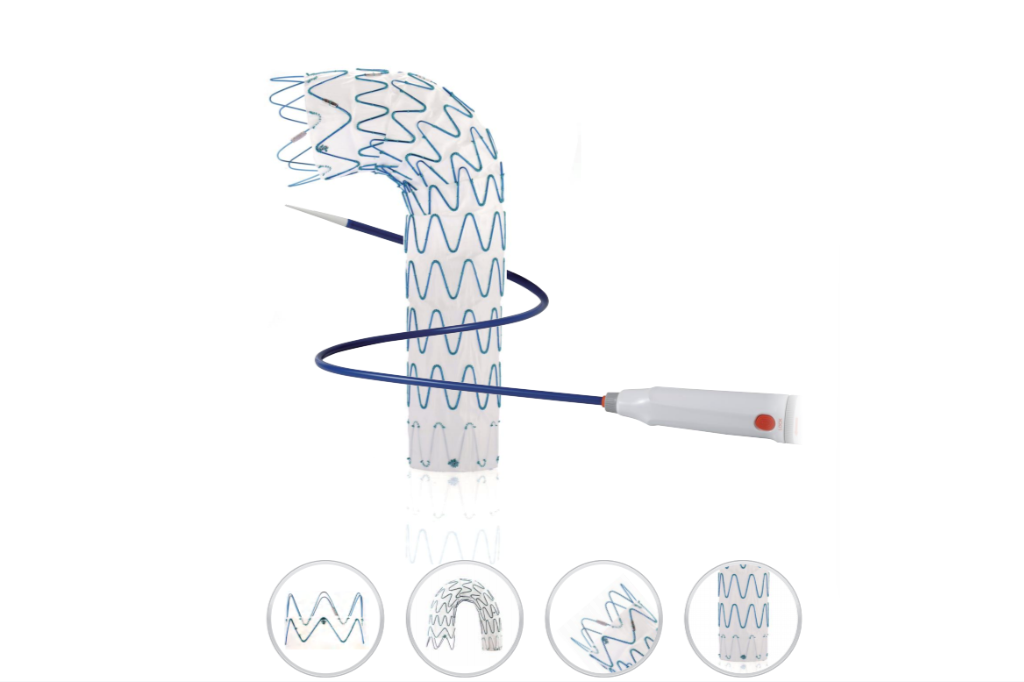
The proximal sealing zone in thoracic endovascular repair often sits across a sharply angled aortic arch. Standard cuffs with fixed cylindrical geometry can leave a wedge-shaped gap along the inner curvature, especially when the arch angle exceeds about 60 degrees. A conformable proximal cuff addresses this by allowing the sealing stent to flex and adapt to the arch contour without losing radial force. The result is more complete apposition around the entire circumference of the landing zone.
Cadaver and imaging studies show that steep arch angles amplify the risk of bird-beak configuration and type Ia endoleak. Cuffs designed with segmented or interrupted stent frames, softer connecting bridges, and controlled radial stiffness distribute wall contact more evenly. Instead of forcing the aorta to match the device, the cuff yields just enough to follow the outer and inner curves. That reduces focal stress at the lesser curvature and keeps the fabric in contact where leaks typically start.
Matching steep arch angles is not simply about adding flexibility. If a cuff becomes too soft, it can lose seal under pulsatile displacement or fail to maintain columnar support for the rest of the graft. The better designs balance conformability with enough outward force, using hoop strength that varies along the length or around the circumference. This lets the proximal edge settle into the arch with minimal guttering and stable long-term fixation.
Nitinol Frame Tweaks That Lower Chronic Outward Force
Traditional nitinol frame geometries often rely on uniform strut thickness and sharp diamond-cell corners, which can translate into an unnecessarily high chronic outward force once the device is deployed. One effective tweak is to replace those tight corners with progressive radii and introduce slight asymmetries in the strut junction. This spreads the phase-transition strain over a larger volume, so the frame settles into a lower-energy diameter after unloading rather than pushing continuously against the vessel wall. The result is a more compliant long-term fit without sacrificing the acute radial stiffness needed during placement.
Thermomechanical processing offers another direct route to reducing chronic outward force. By shifting the austenite finish temperature closer to body temperature and then applying a brief low-temperature aging step, the upper plateau stress of the stress-strain curve can be dropped significantly. Many designers overlook this because they focus only on Af, but the real control comes from the combination of cold work, final shape setting, and post-set aging. A well-tuned process can lower chronic outward force by twenty percent or more while keeping the hysteresis narrow and the fatigue life intact.
A less obvious strategy is to interrupt the continuous load path by selectively removing material in low-stress zones. Small elliptical cutouts or shallow grooves near the nodes break the force transmission that normally keeps the frame pressing outward. Unlike simply thinning the entire strut, these local modifications preserve buckling resistance and fatigue strength, yet they allow the structure to relax more readily after expansion. The overall effect is a flatter chronic outward force curve, which is especially valuable in delicate vessels where long-term radial pressure drives restenosis.
Multicenter Chinese Data on Endoleak and Migration Rates
Endoleak and migration after endovascular aneurysm repair remain key concerns in routine follow-up, but most published benchmarks come from Western registries. A recent multicenter review of Chinese centers offers a closer look at how these events unfold in a different patient mix, where aortic anatomy and device selection patterns vary from those seen in North America and Europe.
Across the participating Chinese hospitals, the pooled early type I and type III endoleak rates stayed low, while type II endoleaks were the most frequently observed. Migration rates at one year also fell within single-digit percentages, though the numbers fluctuated by center volume and the generation of stent graft used. The data suggest that contemporary devices perform consistently in this population, but surveillance intensity differed enough to influence detection.
What stands out is the value of pooling follow-up imaging from multiple centers rather than relying on isolated institutional series. The Chinese dataset adds useful volume to the global picture, particularly for longer-neck and more tortuous anatomies that are common in this cohort. It reinforces that migration and clinically significant endoleak are uncommon, but their detection depends heavily on standardized computed tomography follow-up rather than symptom-driven visits alone.
Tapered Graft Bodies Reflecting Asian Aortic Dimensions
Asian patients often present with aortic necks and iliac arteries that taper more abruptly than those seen in Western populations. A straight cylindrical graft can leave gaps at the distal seal zone or require aggressive oversizing, which raises the risk of late endoleaks and limb kinks. By turning to a tapered body design, the graft follows the native reduction in lumen diameter from the proximal neck toward the iliac bifurcation more naturally.
The taper geometry is not a one-size-fits-all compromise. Diameter step-downs are matched to published morphometric data from Asian registries, where proximal aortic necks average smaller and taper over a shorter distance. This means the device sits into the anatomy rather than forcing the anatomy to accommodate the device. The gradual reduction also helps distribute radial force more evenly along the landing zone, preserving branch patency and reducing the chance of distal neck dilatation over time.
At the procedural level, the tapered body simplifies sizing when confronted with a narrow distal aorta or calcified iliac access. Operators can choose a graft whose proximal and distal diameters correspond closely to the patient's own measurements, avoiding the need for extender cuffs or excessive ballooning. This design choice reflects a practical shift toward treating the aorta as it is found in Asian patients, not as an idealized Western template.
Off-the-Shelf Fenestrated Options for Arch Branch Vessels
Off-the-shelf fenestrated endografts for the aortic arch remove the most stubborn bottleneck in emergent endovascular repair: the weeks-long wait for a patient-specific device. These systems arrive with pre-cut openings for the innominate, left common carotid, and left subclavian arteries, configured around a standardized arch geometry rather than an individual CT dataset. The proximal sealing zone sits in the ascending aorta, and each fenestration is reinforced with a radiopaque border to guide bridging stent deployment. Not every arch will fit the template, but for those that do, the ability to proceed within days instead of months changes the calculus for symptomatic patients who are poor candidates for open surgery.
That speed does not come at the cost of reliability. Because the fenestration positions, branch cuff angles, and delivery system deployment steps are identical across every unit, operators accumulate experience far faster than with bespoke grafts. The manufacturing process is subject to the same batch-level quality controls as other mass-produced endovascular components, which reduces the risk of a mismarked fenestration or a misplaced marker. Anatomical screening remains strict, though. A usable off-the-shelf arch device generally requires a minimum length of parallel ascending aorta, limited arch angulation, and branch origins that fall within a defined clock-face range. When those criteria are met, the procedure becomes almost mechanical—cannulate each fenestration, place a bridging stent, and repeat.
Centers that have adopted these systems often describe a shift in their referral patterns. Patients who previously would have been turned down for endovascular repair due to manufacturing timelines now come through the hybrid room within a week of imaging. The trade-off is that off-the-shelf configurations handle the most common arch branch anatomies well but struggle with unusual vessel takeoffs or severe tortuosity. In those outliers, the extra time spent waiting for a custom graft is still justified. For everyone else, having a fenestrated arch option on the shelf means the decision to treat no longer hinges on a production schedule.
FAQ
Recent systems incorporate lower-profile delivery catheters that allow percutaneous access, reducing vascular complications. The stent structure often uses a combination of nitinol rings and polyester fabric, with improved radial force to maintain seal in tortuous anatomy. Some grafts feature pre-curved designs that better conform to the aortic arch, and integrated bare springs at the proximal end enhance fixation without requiring extensive landing zones.
Many new systems offer fenestrated or branched configurations that preserve supra-aortic vessel flow. In situ fenestration using laser or needle puncture has gained traction in Chinese centers, letting physicians create custom openings during the procedure. This approach reduces the need for pre-customized devices and shortens the waiting time for urgent cases.
Yes, manufacturers have shifted toward low-porosity woven polyester or ePTFE fabric to reduce endoleak risk. Nitinol stents with enhanced fatigue resistance are used, and some grafts feature a heparin-coated surface to lower thrombogenicity. The suture lines are also redesigned to minimize abrasion against the fabric during cyclic loading, which is a common failure point in older grafts.
Several multi-center registries in China have reported high technical success rates exceeding 95% for thoracic aortic dissection and aneurysm repair. Mid-term follow-up data show low rates of stent migration and type I endoleak. Real-world studies also highlight lower access-site complications thanks to the reduced delivery profile, making the devices suitable for patients with smaller iliac arteries.
Chinese patients with aortic disease often present at a younger age with a higher incidence of aortic dissection related to hypertension. The new grafts are designed with more flexible body segments to accommodate the sharper aortic arch angles seen in Asian populations. Additionally, some systems offer shorter lengths and tapered configurations to fit the smaller aortic diameters commonly found in Chinese patients.
Chinese medical centers have established simulation-based training programs and cadaver workshops to teach the use of fenestrated and branched grafts. Industry-sponsored proctorships allow experienced operators to guide their peers through first cases. This mentorship model has been crucial because the techniques, especially in situ fenestration, require precise catheter control and real-time imaging interpretation.
The National Medical Products Administration has streamlined approval for innovative cardiovascular devices, encouraging domestic manufacturers to iterate quickly. Cost pressures from volume-based procurement have pushed companies to optimize manufacturing efficiency without sacrificing quality. As a result, Chinese stent grafts often come at a lower price point than imported equivalents, improving access for patients across different hospital tiers.
Expect further integration of imaging modalities like intravascular ultrasound and CT fusion to guide real-time deployment. Bioabsorbable stent components are being explored to reduce long-term foreign body burden. There is also a push toward off-the-shelf branched grafts that can be stockpiled in emergency departments, minimizing the delay for complex arch repairs.
Conclusion
Chinese thoracic aortic stent graft systems now incorporate several engineering shifts that directly address anatomy often seen in local patient populations. Low-profile introducers, for instance, allow deployment through heavily calcified or narrow iliac arteries that would otherwise require open access. The proximal cuffs are designed with added conformability to match steep arch angles, which reduces the "bird-beak" gap and improves seal. Beyond geometry, the nitinol frames have been reworked to lower chronic outward force, meaning the stent applies less continuous radial pressure on the aortic wall—this is particularly relevant for fragile or dissected tissue. These are not minor tweaks; they change how the device behaves over years rather than just at implant.
Multicenter Chinese data on endoleak and migration rates show that these design choices translate into measurable clinical outcomes, with low type Ia endoleak and minimal downward displacement compared with earlier fixed-profile frames. Tapered graft bodies have also been introduced to better match the smaller and more variable aortic dimensions common in Asian patients, avoiding oversizing that can lead to new entry tears or distal neck dilation. Another notable step is the availability of off-the-shelf fenestrated options for arch branch vessels, which means surgeons can preserve supra-aortic branches without custom waiting times. Together, these developments reflect a shift from simply adapting Western grafts to building systems around the specific biomechanical and anatomical realities seen in Chinese aortic repair.
Contact Us
Contact Person: Jeffrey
Email: [email protected]
Tel/WhatsApp: 86-0633-2230056
Website: https://www.sd-intmedical.com