

Flap Gate Valve Supplier Guide to Reliable Flow Control Solutions
2026-08-30
Most flow control failures don’t start with the valve itself—they start with the supplier choice. A flap gate valve that sticks, leaks, or corrodes can quietly disrupt operations long before anyone notices. This guide cuts through the usual supplier claims and focuses on what actually matters for reliable flow control. Drawing on real engineering insight from THT, we’ll explore how to evaluate suppliers, avoid common pitfalls, and choose a solution that holds up under pressure. Because when flow control matters, guesswork is the last thing you need.
The Real Reason Flap Gate Valves Fail Early
Most people blame the seal or the hinge pin when a flap gate valve gives out early, but the real culprit is almost always backpressure instability. The valve is designed to open with forward flow and snap shut when flow reverses, yet in systems with abrupt pump stops or surging, the disc slams repeatedly against the seat. That hammering doesn't just wear the rubber—it fatigues the hinge and loosens the mounting hardware long before the material's rated life.
Another overlooked factor is debris accumulation at the hinge point. Flap gates installed downstream of storm drains or sewage lift stations get coated with stringy solids, hair, and grease. Once the hinge loses its full range of motion, the gate stays partially open during reverse flow, allowing backflow to erode the seat edge and create a leak path. Operators often replace the gate with a heavier-duty model, but if the hinge geometry isn't self-clearing, the same failure returns within months.
Installation angle also quietly shortens service life. A flap gate that isn't perfectly vertical in still water, or one bolted to a pipe with slight misalignment, will have the disc resting on the seat unevenly. That corner contact point becomes a stress riser, and combined with thermal expansion on long discharge lines, it starts a crack at the outer edge. The fix isn't a thicker disc—it's checking the mounting face flatness and giving the valve enough clearance to swing freely without rubbing against the pipe wall.
How Reliable Suppliers Test for Zero Leakage Before Shipping
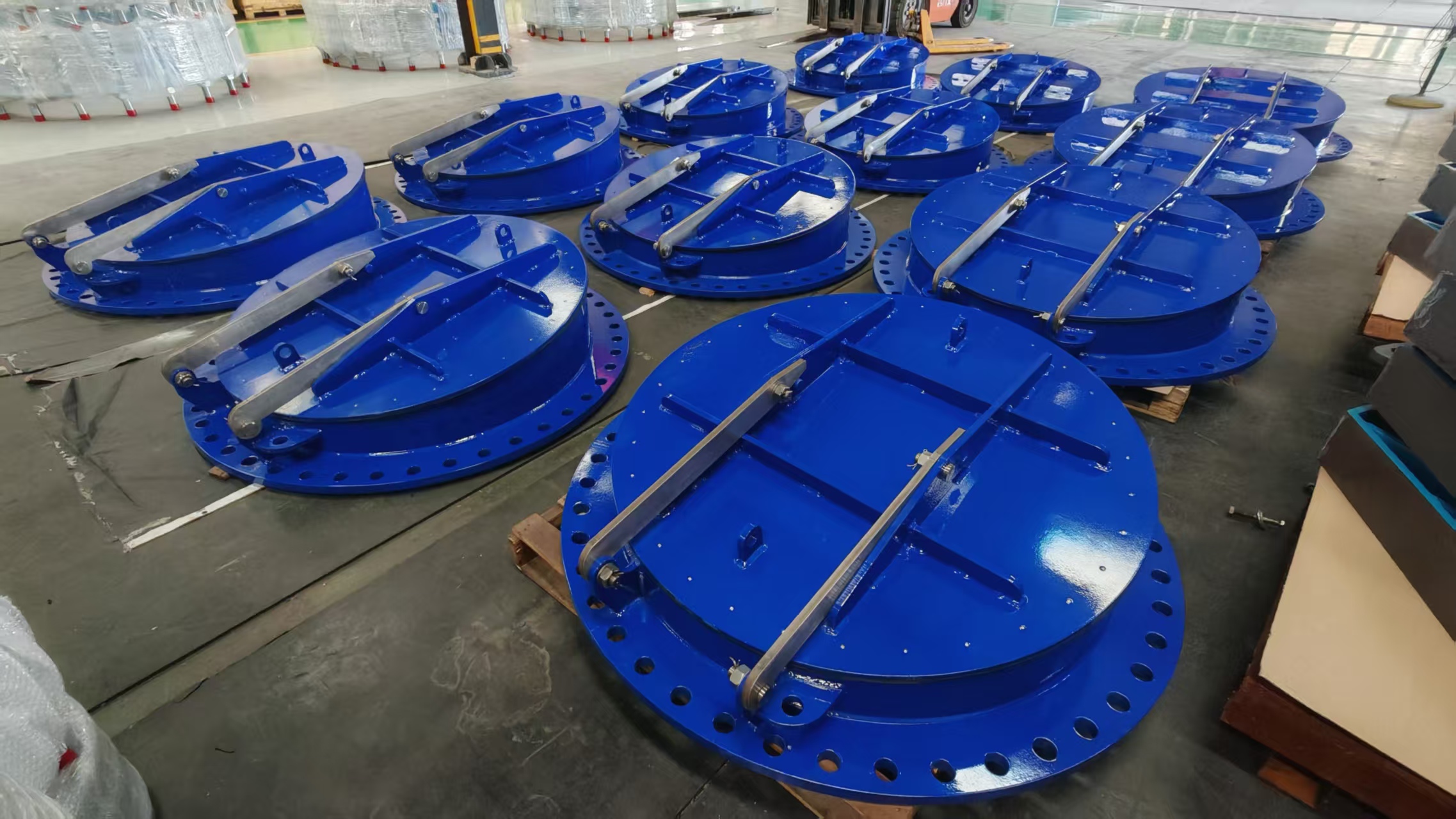
A trustworthy supplier doesn't just assume a valve or fitting is leak-free because it came off the assembly line looking fine. Before anything gets packed into a crate, each unit goes through a series of checks that simulate the exact conditions it will face in the field. This might mean pressurizing the component with nitrogen, submerging it in a water tank, and watching for even the smallest bubble stream that would indicate a micro-leak. For high-purity or gas applications, a simple bubble test isn't enough—suppliers often switch to helium mass spectrometry, where the tiniest helium atom escaping from a joint gets detected by a sensor that can pick up leaks down to 1×10^-9 mbar·L/s.
Pressure decay testing is another common method. The part is filled to a set pressure, then isolated from the source. A precision transducer monitors internal pressure over a set time window—any drop beyond a tiny tolerance means air is escaping somewhere. Good suppliers will run this test multiple times at different pressure levels, sometimes with thermal stabilization to rule out temperature-induced pressure changes. They also test in both directions when the component has a preferred flow path, because a seal that holds in one orientation might weep when pressure hits from the other side.
What separates a reliable supplier from a merely compliant one is that they test every single unit, not a random sample off the batch. They keep records linking each serial number to its test data, so if a leak ever shows up in the field, they can trace it back to the exact test conditions that were applied. Some suppliers even go beyond the required industry standards—like API 598 or ISO 5208 for valves—and add their own internal acceptance criteria that are tighter than what the spec demands. That's the kind of over-testing that makes a zero-leakage claim actually mean something.
Choosing Between Cast Iron, Stainless, or Aluminum Bodies
Cast iron remains the workhorse when upfront cost and damping matter more than weight. Its graphite-rich structure soaks up vibration, which is why you still see it on compressors and pump housings where constant humming would otherwise fatigue thinner materials. The trade-off is brittleness and a tendency to corrode if the coating gets scratched, so keep it away from untreated water lines unless you enjoy chasing rust blooms.
Stainless earns its premium in wet, acidic, or sanitary environments. Instead of relying on a surface coating, the chromium oxide layer rebuilds itself after minor scratches, which means a scratched flange won't turn into a corrosion hot spot overnight. That self-healing property is why food plants and coastal installations lean heavily on 316 stainless, even though it costs three to five times more than a comparable cast iron body and adds noticeable heft.
Aluminum slots in where weight and heat transfer dominate the decision. It weighs roughly a third of stainless and sheds heat quickly, so portable pumps, valve bodies on mobile equipment, and air-cooled housings all favor it. The downside is galling on threaded connections and a softness that makes over-tightening a real risk. If your maintenance crew tends to crank bolts until they stop, aluminum will teach them expensive lessons.
Why Backpressure Ratings Are Often Misread
A backpressure rating looks like a hard limit, but it's actually a snapshot taken under a specific set of test conditions. The temperature, media, and even the direction of flow during the test rarely match what the valve or regulator sees in the field. Metal seats soften at elevated temperatures, seals lose resilience, and a rating measured with cold water on a bench can shrink noticeably once steam or hot oil is running through the same port. If someone reads the stamped number without checking the fine print on the data sheet, they're already setting themselves up for a surprise.
Part of the confusion comes from mixing up backpressure with differential pressure. Backpressure is the pressure on the outlet side of a device, but the rating often refers to the maximum backpressure a closed valve can hold without leaking—not the pressure difference it can handle while opening or modulating. In a check valve, for instance, the disc may stay seated under high backpressure, yet the same valve can fail to open if the inlet pressure isn't enough to overcome both the backpressure and the spring force. So the “rating” gets quoted in situations where it doesn't apply at all.
Different test standards make the problem worse. One manufacturer may rate backpressure using clean hydraulic oil at room temperature, while another uses compressed air and a safety factor that isn't spelled out on the casting. There's no universal requirement to print the test method next to the rating, so two valves with the same stamped figure can behave quite differently under identical service conditions. Unless the user digs into the installation bulletin or asks for the test report, the number on the nameplate is easy to misread as a promise it was never meant to be.
A Practical Checklist for Comparing Supplier Quotes
When you line up quotes from different suppliers, the numbers on the page rarely tell the whole story. A lower unit price can hide steep shipping fees, longer lead times, or payment terms that squeeze your cash flow. Start by confirming that each quote covers the exact same specifications, quantities, and delivery location—otherwise you're comparing apples to conveyor belts. Then pull apart the fine print: warranty periods, return policies, and whether setup or tooling costs are amortized into the piece price or billed separately.
Next, look beyond the dollar figure to the supplier's responsiveness and track record. Ask for two or three recent references in your industry and actually call them. Listen for how the supplier handled a late shipment, a quality spill, or a sudden design change. A quote that arrives in 24 hours with clear line-item breakdowns often signals a more organized operation than one that takes a week and arrives as a single lump sum. Also note who you're dealing with—if you can't reach a real engineer or account manager during the quote stage, that friction will likely continue after the purchase order is signed.
Finally, build a simple scorecard before you negotiate. Give each quote a weighted score for price, lead time, payment terms, warranty, and communication. Don't let the cheapest option win by default; instead, use the scorecard to challenge suppliers. Tell the low-price bidder they lost points on lead time, and ask if they can improve it. Tell the high-service bidder their warranty is strong but their price is 12% above the median—can they meet you halfway? This turns quote comparison from a passive spreadsheet task into an active tool for shaping better offers, and it keeps your team aligned on what actually matters for the project.
Installation Mistakes That Void Flap Gate Valve Warranties
Flap gate valves are often installed without checking the flange alignment, and this is one of the quickest ways to lose warranty coverage. When the mating flanges are not parallel or the bolt holes are forced into position, the valve body takes on stress it was never designed to handle. Over time this stress concentrates around the hinge area and can cause hairline cracks or uneven seating. Manufacturers can easily spot these stress patterns during a warranty inspection and will reject claims because the damage stems from installation, not from a material or workmanship defect.
Another common mistake is uneven bolt tightening or using the wrong torque sequence. Many crews tighten bolts in a circular pattern to save time, but this pulls one side of the valve tighter than the other. The resulting distortion may not be visible from the outside, yet it is enough to break the seal between the flapper and the seat. Once the valve starts leaking after installation, the manufacturer will ask for installation records. If the torque pattern was not followed or the bolts were over-tightened, the warranty is typically void on the spot.
A third issue is failing to support the weight of the downstream piping. Flap gate valves are not designed to act as pipe hangers. When a heavy run of pipe is left hanging off the valve flange, the constant bending load can warp the body or pull the hinge pin out of alignment. This type of damage is easy to identify because the wear marks are concentrated on one side of the seat. Since the root cause is an installation oversight rather than a product fault, the manufacturer will not cover the repair or replacement costs.
FAQ
Ask whether they can provide pressure test results or at least seat leakage data for your specific size. Do not settle for a generic brochure. Request details on hinge pin material, seal retention method, and whether the gate is field-adjustable. A supplier worth their salt will also ask you about the pipe slope, upstream debris load, and frequency of reverse flow before recommending anything.
The gate is weighted or spring-assisted to sit against a seat ring. Forward flow pushes it open; when flow stops or tries to reverse, the gate falls shut or is pushed shut by the backpressure. The reliability comes from the seat compression and hinge alignment. If those two are done poorly, even a small piece of grit can hold the gate open and let water sneak back.
For raw sewage, EPDM is common because it handles organic acids and abrasion reasonably well. For saltwater or brackish outfalls, Buna-N or neoprene often holds up better against oil and marine growth. If you have chemical exposure, ask about Viton. Do not just assume rubber is rubber; the wrong seat can turn a valve into a maintenance headache within a season.
Yes, a lot. Most flap gates work best installed on a horizontal or slightly downward sloping pipe so gravity helps close them. If the pipe runs vertically or the gate must open upward, you may need a counterweight or spring. Make sure your supplier knows the exact pipe angle and where the gate sits relative to the floor or channel wall.
They can, but you have to design for it. A flat-faced gate with a tight seat will catch rags and stringy debris easily. Look for a supplier who offers a recessed or angled seat, a wider hinge clearance, and maybe a debris shield. Also ask about the gap between the gate and frame at full open; that is where most clogs begin.
In stormwater, check them at least twice a year and after every major rain event. Look for torn seats, bent hinges, or debris wedged under the gate lip. Many failures happen not because the valve wore out, but because someone ignored a small obstruction until it eroded the seat. A quick visual check beats a costly bypass repair later.
Flanged connections give you a bolted, rigid joint, which is easier to service or replace without cutting pipe. Slip-on models are faster to install and often used for corrugated pipe or retrofit jobs. The choice comes down to whether you need future removal or cheaper installation. A reliable supplier will not push one over the other; they will ask what kind of pipe you are connecting to.
A heavier gate closes more positively, but it also needs more head to open. If your line runs at low flow, a heavy gate may never fully open and you get upstream ponding. The supplier should calculate the opening force based on your minimum flow depth and velocity. If they cannot do that, keep looking.
Conclusion
Many flap gate valves are pulled from service long before their expected lifespan, and the root cause usually traces back to a few overlooked details rather than a single catastrophic flaw. Corrosion at the hinge, debris wedging between the disc and seat, and improper sizing all show up repeatedly in field reports, yet these issues are rarely addressed in generic product descriptions. A dependable supplier, however, screens for exactly these vulnerabilities by running zero-leakage tests under backpressure conditions that mimic real system spikes. These tests matter because a valve that seals well at low pressure can fail once flow reverses or surges. Material selection plays an equally direct role: cast iron offers solid economy for basic wastewater lines, stainless steel handles aggressive or high-chloride environments, and aluminum suits lightweight drainage applications where ease of installation outweighs extreme wear resistance.
Backpressure ratings, despite being printed in catalogs, are frequently misread because they depend on both the direction of flow and the mounting orientation; a flap gate rated for one gravity-fed scenario may not hold up under a mixed-pressure surge. When reviewing quotes, buyers should move past the headline price and check whether the supplier includes hinge pins, seals, and frame mounting hardware as standard or as add-ons. Even the best valve can fail early if the installer bolts it into an uneven frame, forgets to allow clearance for the disc to swing fully, or uses a gasket that shifts during tightening. These mistakes often void warranties without the buyer realizing it. By asking for documented test reports, clarifying material compatibility with the actual fluid, and confirming backpressure limits for both seating and reverse flow, plant operators end up with a flap gate valve that holds up over time instead of becoming another premature replacement.
Contact Us
Contact Person: Su Zhang
Email: [email protected]
Tel/WhatsApp: +86-25219206
Website: https://www.tht-valve.com/