

OEM Extruder Solutions for Custom Manufacturing Needs
2026-10-31
Finding an extrusion partner that truly adapts to your production line can feel like searching for a needle in a haystack. Most suppliers offer off-the-shelf machines, but your custom manufacturing needs demand more than a one-size-fits-all approach. That’s where SFC steps in with OEM extruder solutions built around your exact specifications—not the other way around. In this post, we’ll explore how tailored extrusion technology can streamline your process, reduce waste, and unlock new possibilities for complex profiles.
Screw Geometry Tailored to Your Resin's Behavior
Resin behavior changes from lot to lot and grade to grade, but a screw should not force every material through the same shear history. Designing around your resin starts with mapping viscosity under the screw's actual shear rates, not just a single melt flow number. A high-shear zone that helps one polymer may tear apart another, so the transition length, barrier clearance, and mixing pins are all adjusted to match how your specific resin responds.
For heat-sensitive or shear-sensitive resins, flight radii and channel depths get smoother to avoid dead spots where material can sit and degrade. For highly filled or reinforced grades, wear-resistant geometry and modified compression ratios prevent excessive fiber breakage while still feeding consistently. The geometry then becomes a direct reflection of the resin’s curve: not a standard profile, but a purpose-built path from pellets to melt.
Bridging the Gap Between Lab-Scale and Full-Scale Extrusion
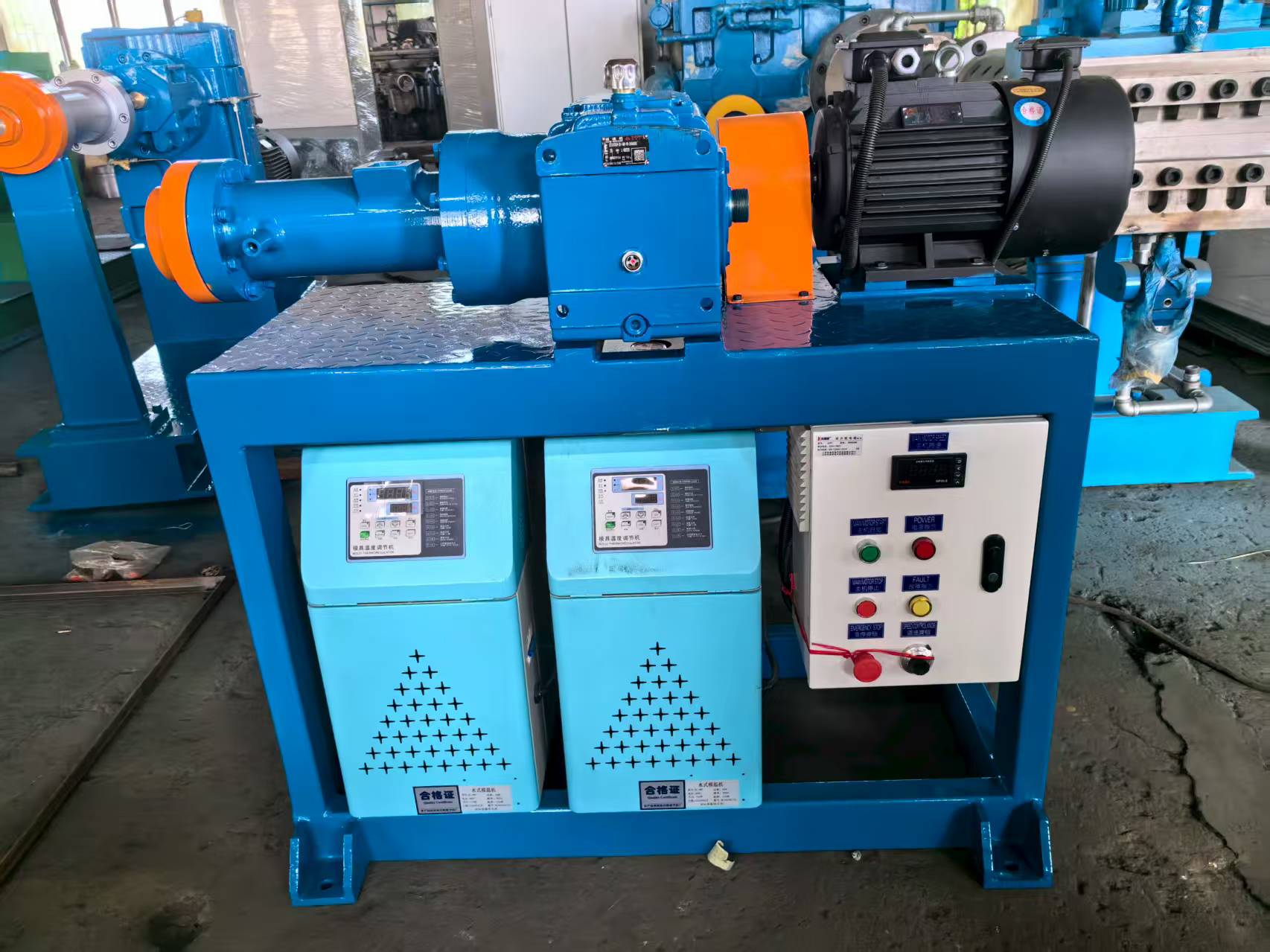
Scaling up extrusion from a benchtop twin-screw unit to a production line often exposes mismatches that lab data never predicted. Small machines mask residence time distribution issues because material passes through quickly with minimal thermal degradation. Yet once screw diameter triples or more, the surface-to-volume ratio drops sharply, and polymer near the barrel wall can linger far longer than the mean residence time. Operators who rely solely on lab torque readings or melt temperature probes will miss the slow, uneven heating that causes localized gel formation or additive decomposition in full-scale barrels.
A practical bridge involves running what process engineers call “scale-down validation” instead of blind scale-up. This means deliberately narrowing the lab extruder’s operating window to mimic the high shear and long thermal history of the production line. For example, lowering lab screw speed while raising barrel set points forces the material to experience similar specific mechanical energy input per unit mass. Simultaneously, sampling the lab extrudate at multiple die positions—not just the centerline—reveals radial temperature gradients that typically worsen at larger diameters. These data feed directly into full-scale startup recipes, reducing the trial-and-error runs that waste resin and production hours.
Beyond parameter matching, the gap closes when teams treat the lab extruder as a sensor rather than a miniature factory. Installing a melt pump or a slit rheometer on the benchtop unit captures viscosity under realistic shear rates, while inline near-infrared probes track moisture or filler dispersion that static lab tests miss. The most successful transitions we have observed pair these measurements with a first production batch deliberately run at eighty percent of target throughput, allowing the full-scale thermal profile to stabilize before ramping up. That staged approach converts the unpredictable jump from lab to floor into a controlled handoff, where deviations become tuning signals instead of failures.
Barrel and Screw Materials for Aggressive Compounds
Processing glass-filled or chemically aggressive resins quickly exposes the limits of standard nitrided steel. The continuous scouring from abrasive additives wears down flight lands and check rings, while acidic byproducts from flame-retardant or recycled materials pit the screw root. Upgrading to a bimetallic barrel with a cast-in liner of nickel-rich alloy, paired with a screw hard-faced using cobalt-based or tungsten carbide coatings, shifts the failure mode from rapid erosion to gradual, predictable wear. These material combinations maintain tighter clearances longer, which directly stabilizes melt temperature and shot consistency.
The screw itself often benefits from a powder metallurgy approach. Instead of a single uniform steel, high-performance screws use a tough core for torque transmission and a wear-resistant surface layer deposited by HIP or laser cladding. For extremely corrosive environments, a fully hardened stainless tool steel with high chromium and molybdenum content resists both chemical attack and mechanical abrasion. It is not simply about hardness; the microstructure must balance compressive strength with enough ductility to prevent brittle fracture under high back pressure or occasional cold starts.
Barrel selection follows similar logic. A through-hardened barrel offers a modest improvement over nitriding, but a true bimetallic liner, typically 1.5–3 mm thick, provides a metallurgical bond that will not delaminate under thermal cycling. For compounds containing halogenated flame retardants, a liner with 55–60% nickel and a balanced mix of chromium, boron, and silicon delivers the best resistance to hydrochloric acid generation. Matching the screw surface to the barrel liner—not using identical materials but compatible hardness differentials—prevents galling and extends the useful life of both components well beyond what a standard general-purpose screw would achieve.
Reducing Setup Time on Custom Extrusion Jobs
The usual bottleneck isn't the extruder itself; it's the minutes lost hunting for the right die, pulling leftover polymer from the previous run, and re-zeroing the puller. A simple changeover cart stocked with dedicated cleanup tools, preheated die packs, and color-coded shims cuts most of that fumbling. Having the next job's setup sheet laminated at the line—not buried on a shared drive—lets operators stage temperature profiles and downstream calibrators before the current run ends.
Another overlooked win is splitting setups into external and internal tasks. Anything that can happen while the line is still running—pre-assembling the screen pack, verifying barrel temperatures, staging the vacuum tank for a different profile—should be done before the barrel empties. Then the internal work shrinks to pulling the old die, purging, and mounting the prepped tooling. Some shops cut changeover time by a third just by moving purge compound and torque wrenches within arm's reach of the breaker plate.
It also pays to record setup parameters, not just product specs. Instead of starting from scratch every time, operators can reference the last good run's actual melt temperatures, screw speed, and calibrator positions. A simple log or photo of the die stack during teardown prevents re-solving the same alignment problem on repeat orders. Over time, those notes become the quickest training tool for new operators and remove the silent trial-and-error that inflates downtime.
The Case for Collaborative OEM Extruder Design
Most extrusion projects still begin with a one-way handoff: the product team locks in specs, procurement sends the package to a supplier, and engineering gets whatever machine arrives. That sequence quietly bakes in compromises. When the OEM is brought in only after the design freeze, the extruder must be adapted to a process that has already been decided, rather than shaping the process itself. The result is often a machine that works on paper but fights the material, the tooling, or the line speed in daily production.
Collaborative extruder design flips the sequence. Instead of treating the machine as a commodity to be quoted, the OEM participates during the early stages of product and tooling development. Screw geometry, barrel venting, temperature zones, and feed throat design are discussed alongside part geometry and material choice. One project might reveal that a slightly different melt temperature allows a shorter barrel without sacrificing output. Another might show that a two-stage screw eliminates a downstream degassing step. These are not exotic changes; they are the kind of practical adjustments that happen only when the machine builder can push back before everything is frozen.
The payoff shows up in unglamorous places: fewer purging cycles during material changes, stable pressure at the die, less scrap during startup, and the ability to run a wider range of regrind without dialing back line speed. A truly collaborative design process also leaves better documentation behind, because the rationale for each choice is recorded during the discussion, not reverse-engineered after installation. In an industry where margins are tight and uptime is everything, that early conversation between product engineering and the extruder OEM is not a delay. It is one of the cheapest performance upgrades a line will ever get.
Validating Output Rates Before Finalizing Your Line
When you're close to locking in a line's capacity, the numbers on paper often hide small operational frictions. Running a short but high-volume trial can reveal whether the stated output rate survives contact with real shift changes, material feed hiccups, or minor stoppages. The goal isn't to chase a perfect theoretical rate, but to find the sustainable pace your crew and equipment can actually hold across a full shift.
Check variance, not just the average. A line that hits 200 units an hour for three hours but drops to 140 after lunch will scramble any downstream schedule built on flat assumptions. Watch where the dips happen and whether they repeat daily. If you can remove or reduce those repeat dips before finalizing, the quoted output rate becomes a promise you can keep instead of a number you'll defend in every review meeting.
FAQ
We start with a conversation, not a quote. You share the current specs, even if rough, and we point out what’s workable, what might shift, and what it could mean for tooling or lead time. That way, by the time the drawing is locked, there are no surprises.
Yes. We’ve built systems for filled compounds, high-temperature resins, soft durometers, and recycled blends. The key is matching screw geometry and temperature zones to the material’s shear sensitivity, which we map out before any cutting starts.
It’s a four-stage loop: discovery, where we learn your part and volume; design, where we propose barrel, screw, and downstream options; build, with regular photo updates; and validation, where we run trials on your actual material before shipment.
Absolutely. We keep a full record of your machine’s config and can adjust screw profiles, add a venting port, or modify the downstream cutter without a full rebuild. Several clients have repurposed lines from one product family to another.
We modularize wherever possible. Standard bases, gearboxes, and control cabinets are stocked, while custom work goes into the screw, die, and specific zones. That typically cuts 3-5 weeks compared to fully bespoke builds without limiting what you can specify.
Medical tubing, wire and cable, automotive seals, food packaging, and industrial profiles. In each case, the machine had to hit different cleanliness, speed, or tolerance targets, so the common thread is less about the industry and more about the tightness of the spec.
Because standard machines force your product into their envelope. Our lines are built around your material, output rate, and floor space. If you’re making something that doesn’t quite fit a stock barrel length or screw ratio, that’s exactly where we come in.
Yes, frequently. We’ve matched line speeds with existing pullers, spliced into legacy controls, and designed die adapters to fit older crossheads. Bring us photos and specs of what you have, and we’ll propose the cleanest hand-off points.
Conclusion
Custom extrusion jobs often fail when a standard screw is pushed beyond its comfort zone. Tailoring screw geometry to the resin's actual behavior—whether it shear-thins aggressively or holds heat—changes how the melt enters the die and how stable the output remains. Pairing that with barrel and screw materials chosen for abrasive or corrosive fillers keeps wear from quietly degrading tolerances. Instead of treating the extruder as an off-the-shelf item, collaborative OEM extruder design brings the processor's daily realities into the engineering conversation, from purging habits to floor space constraints. That kind of back-and-forth produces a machine that feels less like a compromise and more like a purpose-built tool.
The gap between a successful lab run and a stable full-scale line is where many custom projects stumble. Validating output rates, melt temperature, and pressure profiles on pilot-scale equipment before finalizing the line flags problems while they are still cheap to fix. This bridges lab-scale and full-scale extrusion without gambling on scale-up assumptions. For shops that switch between short-run custom jobs, setup time matters as much as throughput. Quick-change barrel sections, repeatable recipe storage, and simplified screw removal cut hours from changeovers. Reducing setup time on custom extrusion jobs turns smaller batches from an operational headache into a viable business model.
Contact Us
Contact Person: Chen Zhengwei
Email: [email protected]
Tel/WhatsApp: +86-13963975727
Website: https://www.sfcrubbermachine.com