

Urban Pipe Gallery Mold: Which One Is Reliable and Worth the Investment?
2026-10-28
Every infrastructure project starts with the same dilemma: which urban pipe gallery mold will actually hold up under pressure, and which supplier won’t leave you stranded mid-pour? With so many options claiming to be “reliable,” separating proven performance from marketing noise is harder than it should be. That’s where LugongMachinery enters the picture—not as another name in a catalog, but as a benchmark for what a worthwhile investment should look like. In this guide, we’ll break down the real differences between molds that last and those that fail early, so you can make a decision based on engineering, not guesswork.
What Separates a Reliable Urban Pipe Gallery Mold from a Disposable One?
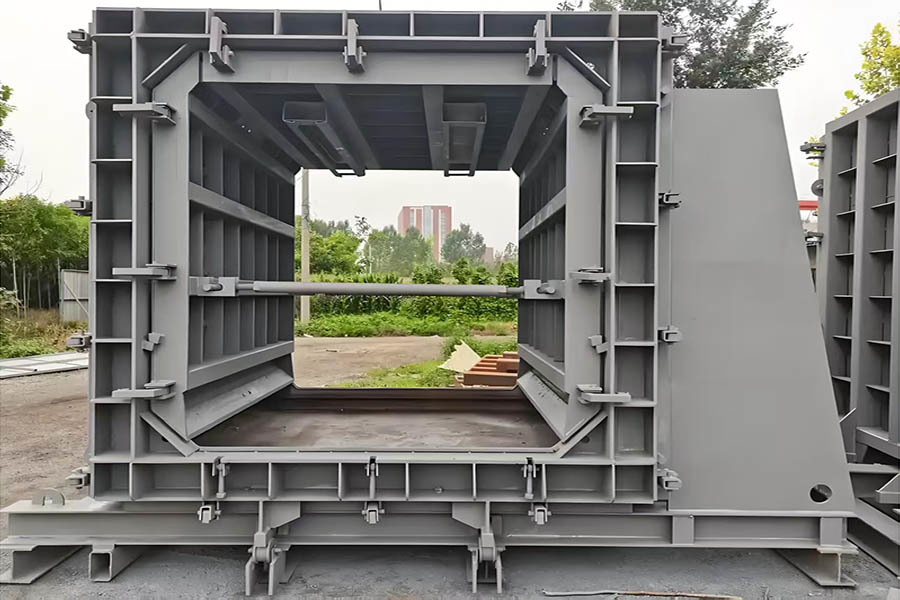
A dependable urban pipe gallery mold isn't just a shaped piece of steel; it's engineered around the brutal realities of repetitive concrete casting under shifting ground conditions. Cheap molds rely on thin plates and spot welds that quietly deform after a few uses, yielding segments that barely meet tolerance on day one and fail outright by week three. A reliable mold, by contrast, starts with heavier ribbing, full-penetration welds, and machined joint faces, so the dimensional drift stays under a millimeter even after hundreds of pours. The difference shows up in the field: segments that align without shims, gaskets that seat fully, and joints that don't leak groundwater into the gallery.
Another tell is how the mold handles stripping and turnaround. Disposable designs often need hammering or pry bars to release the concrete, which chips edges and distorts alignment pins. Reliable molds incorporate proper draft angles, replaceable wear plates, and lifting points placed for balanced crane handling. They also come with maintenance-friendly details—bolt-on end plates, hardened guide bushings, and clear indexing marks—so a crew can reset the mold in minutes, not hours. Those small choices compound: a mold that resets cleanly every cycle keeps production on schedule and prevents the slow creep of error that plagues cheap tooling.
Finally, material selection separates the two. Reliable molds use abrasion-resistant steel on contact faces and normalized structural steel for the frame, sometimes with a stress-relief treatment after welding. Disposable molds often skip these steps, leading to warping, surface scoring, and premature fatigue cracks. In urban environments where a pipe gallery must last decades and resist soil pressure, groundwater, and even seismic movement, the mold's precision directly dictates joint integrity and long-term maintenance costs. The upfront price difference is real, but so is the cost of replacing segments, sealing leaks, and shutting down a gallery for repairs. Reliability is not a luxury; it's a design principle that pays out over the mold's entire service life.
Materials That Actually Survive Years of Underground Stress
Ductile iron is one of the few materials that genuinely earns its place below ground. Unlike the brittle cast iron of a century ago, ductile iron can deform under heavy external loads without fracturing, which means it tolerates soil shifting, traffic vibrations, and freeze-thaw cycles that would snap rigid alternatives. Over time, it builds a stable oxide layer that actually shields the pipe from further corrosion in aggressive groundwater.
High-density polyethylene (HDPE) survives because it refuses to fight the ground. Its flexibility lets a pipeline absorb gradual settlement, differential soil movement, even the occasional small seismic event without losing structural integrity. It also shrugs off chemical attack from acidic soils and stray electrical currents that quickly eat through metal systems, making it a quiet workhorse for buried infrastructure.
Vitrified clay has a track record that few synthetic materials can match. For well over a century, properly installed clay pipe has resisted abrasion from grit, attack from sulfuric acid generated by sewer gases, and general degradation in moist, oxygen-poor conditions. When paired with modern flexible joints, it handles ground movement not by bending, but by letting each segment settle independently without joint failure.
The True Cost of a Cheap Mold You’ll Pay for Later
A cheap mold rarely looks cheap at the quote stage. The cavities get cut, the plates bolt together, and the first samples might even pass a quick visual check. Then the real costs start showing up around cycle five thousand, or sometimes sooner. Ejector pins begin to stick because the holes were reamed too tight. The parting line starts flashing because the steel wasn't hardened deep enough to hold clamping pressure. You end up with a trim operator on every shift, a growing scrap bin, and a toolroom that spends more time patching than maintaining. That initial savings evaporates before the first month of production is over.
The longer-term expense is harder to see but far more damaging. Worn pins and shifting cores let dimensions drift, so a part that measured fine in June is out of tolerance by August. If your customer catches it, you're not just paying for rework—you're paying for sorting, containment, shipping replacements, and maybe losing the next program altogether. The honest comparison isn't between the cheap mold and the expensive one on day one. It's between paying once for a tool that runs predictable parts and paying repeatedly for one that doesn't.
Customizing Your Mold Without Overcomplicating the Job
A mold doesn’t need a dozen interchangeable parts to feel like yours. Start with the shape itself—maybe the rim flares a little wider, or the base gets a soft chamfer instead of a sharp edge. Small geometric tweaks like these change the visual weight without adding assembly steps. If you’re working with a standard two-part mold, consider altering only the cavity insert rather than the whole frame. That single piece can carry a signature curve, a subtle texture, or a recessed logo, and the rest of the tooling stays untouched.
Texture is another low-effort customization lever. A light bead blast on the core gives a matte finish that hides fingerprints, while a polished stripe near the parting line adds contrast. You don’t need to re-machine every surface—mask off one area, treat it differently, and you’ve got a distinct look. For lettering or small graphics, a simple engraved insert costs far less than redesigning the ejection system. Keep the depth shallow, around 0.1 to 0.2 mm, so it releases cleanly without draft issues.
The real trick is deciding what not to change. Over-customizing often leads to undercuts, extra side actions, or fragile thin walls that warp after cooling. Pick one focal point—maybe the top edge, the grip area, or the front face—and leave the rest of the geometry alone. If the mold still cycles fast and ejects smoothly, you’ve customized it without turning a simple job into a headache.
Red Flags That Signal a Supplier Isn’t Worth Your Investment
A supplier who dodges your calls for days yet expects immediate payment on invoices is sending a message louder than any contract: your business doesn't matter enough for basic courtesy. Watch how they handle small hiccups early on. If a missed shipment gets shrugged off with vague excuses instead of a clear plan, imagine the chaos when a major order goes sideways.
Another warning sign hides in their quality history. Ask for samples from recent batches, not just the polished demo from month one. If the materials show inconsistencies, thin spots, or finish flaws that they dismiss as 'within tolerance,' run the math on your return rate. A supplier who accepts defects quietly is one who has stopped improving.
Pay attention to who you actually deal with after the contract is signed. If your dedicated account manager gets replaced by a rotating cast of temps who can't remember your specs, you're no longer a client—you're a queue ticket. Trustworthy suppliers keep your details alive in their systems, not on a sticky note that disappears every quarter.
What Real Urban Pipe Gallery Projects Reveal About Mold Choices
When crews on the Sponge City utility tunnel stretches in Zhengzhou shifted from steel formwork to fiberglass-reinforced polymer molds, the change wasn't driven by upfront cost. It came down to how the material behaved under repeated thermal cycling inside a half-buried gallery. Steel transferred heat unevenly, leaving faint ridge marks where concrete cured faster near the ribs. The polymer molds held a steadier surface temperature, which reduced patching time by roughly a third across a 2.4-kilometer section.
Real projects also expose a less obvious trade-off between rigidity and forgiveness. In the Shanghai Lingang corridor, contractors deliberately oversized the mold joints by a few millimeters to absorb the settlement common in reclaimed land. That small play allowed the cast segments to shift without cracking, something standard precision-machined molds would not have tolerated. It's a reminder that tolerance data from factory floors rarely transfers cleanly to a trench with variable bedding.
Field reports point to maintenance as the real test of mold choices. Galleries cast with reusable modular systems showed more consistent internal dimensions, which mattered when cable brackets and drainage channels had to be retrofitted. In one retrofit in Nanjing, crews spent nearly two weeks shimming and grinding segments cast from mismatched rented molds—time that could have been avoided with a matched set from a single supplier.
FAQ
Look beyond the sales pitch. A dependable mold starts with frame rigidity and precise joint alignment. Ask for sample welds and check whether the manufacturer uses stress-relieved steel plate. If the joints have visible undercut or uneven gaps, walk away.
Steel grade matters more than thickness alone. Q345 or similar structural steel resists deflection better than plain Q235 under repeated vibration. Also check the hardness of the side rails and the quality of the locking pins. Cheap pins wear out quickly and cause misalignment after a few dozen pours.
There is no fixed number because dimensions and complexity vary widely. However, a reasonable benchmark is to compare the mold weight per cubic meter of concrete. If one offer is 20% lighter than others with the same drawing, that usually means thinner plates or fewer stiffeners, which will cost more in repairs later.
Watch for sharp corners on the inside face, missing gussets at high-stress points, and paint that hides weld splatter. Also test the opening and closing mechanism before purchase. If it binds or requires hammering during the demo, that is a red flag.
Usually yes, especially if you expect to pour different pipe gallery sections. Modular panels let you reconfigure the mold for multiple cross-sections instead of buying separate molds. The key is to confirm that the connection system has tapered dowels or positive locks, not just bolts through slotted holes.
At minimum, they should send a technician for the first assembly and first pour. They should also stock replacement parts like side rails, pins, and wedge clamps. Avoid suppliers who only provide a PDF manual and then stop responding. Ask for a written response time guarantee for critical part delivery.
Request a dimensional inspection report from a third party or ask to video call during the pre-shipment check. Measure the diagonal distance, the width at three points along the length, and the flatness of the bottom plate. A tolerance of plus or minus 2 mm on width is acceptable for most urban pipe gallery work.
They focus only on the initial price and ignore the pour cycle time. A mold that is difficult to open and reset will add hours to every pour and require more labor. Calculate the cost per pour over at least 500 cycles. Often a mold that costs 15% more upfront is cheaper by the 100th cycle.
Conclusion
Choosing an urban pipe gallery mold isn't just about picking the lowest bid—it's about knowing which details separate a mold that lasts decades underground from one that warps after a few pours. Reliable molds start with high-grade steel, often Q355 or better, thickened at stress points where concrete pressure peaks. The ones worth buying also have replaceable wear plates and sturdy alignment pins, so after hundreds of casting cycles the joints still close tight. Cheap molds, by contrast, use thinner plate and mild steel that flex under vibration; you'll save now but pay later in cracked panels, leaky seams, and constant rework. Customization should be practical, not overbuilt: adjustable end caps for different gallery lengths, simple bolt-on inserts for pipe openings, and a base frame that can handle minor site-level shifts without twisting.
Real urban pipe gallery projects show that the most dependable suppliers aren't the ones with glossy brochures, but those who can walk you through previous pour logs and show how their molds held dimension after 500-plus uses. Red flags include vague material certifications, no local service support, and delivery promises that seem too good for the current steel market. Investment-wise, a well-made mold may cost 30–50% more up front, but it eliminates the hidden costs of rework, downtime, and early replacement. Ask for a sample corner section, check weld penetration on the ribs, and verify that the supplier has actually delivered to similar underground infrastructure jobs—not just precast yards making above-ground boxes. That combination of honest materials, proven field history, and restrained customization is what makes a mold genuinely worth the money.
Contact Us
Contact Person: Zhang Zhenlai
Email: [email protected]
Tel/WhatsApp: 8618563210000
Website: https://en.lugongmachinery.com/